
The Ultimate Guide to Golden Monkey Tracking in Volcanoes National Park- Rwanda.
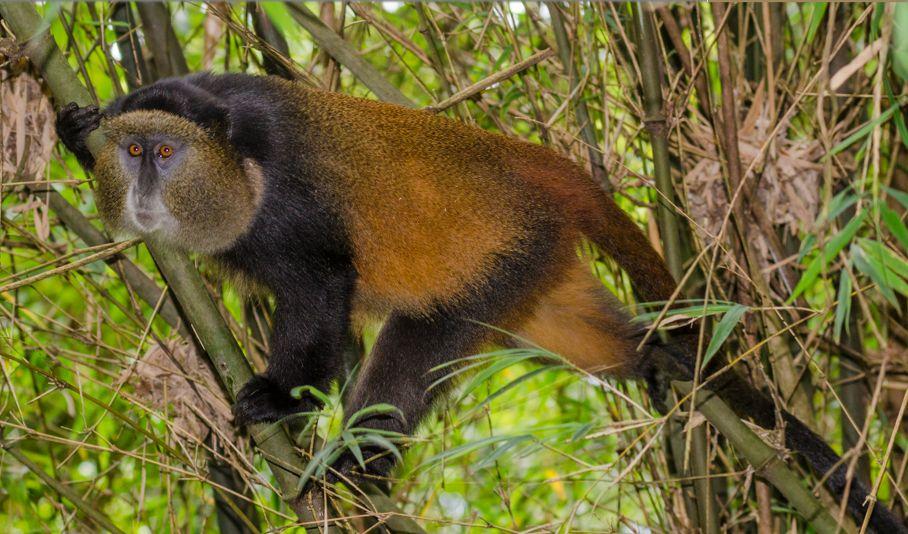
When you ask for what draw most travelers to Rwanda’ volcanoes National Park, the most common answer always the mountain gorillas. But tucked in the same misty bamboo forested zones of the Virunga Massif lives another specie of endangered primate that many visitors end up loving just as much, if not more: the golden monkeys. Playful, agile, endlessly curious, energetic, and their bodies covered with orange and black fur that seems to glow when sunlight cuts through the canopy- golden monkeys are one of Rwanda’s best-kept adventure secrets.
Golden monkey trekking in Rwanda takes place in Volcanoes National Park, northwest of the country, and it offers something gorilla trekking can’t quite match: speed, energy, and a troop that never sits still for long. If you’re planning a primate safari in Rwanda, this guide walks you through everything you need to know before you embark on this moderate forest hike, another opportunity to support Rwanda’s conservation efforts.
Where are Golden Monkeys found?
Golden monkeys (Cercopithecus kandti) are sub species of the blue monkey and are endemic to the Albertine Rift, found only in the Virunga volcanic massif- a chain of eight volcanoes straddling Rwanda, Uganda, and the Democratic Republic of Congo.
In Rwanda, the golden monkeys find refuge in the bamboo and montane forests of Volcanoes National Park, mainly on the lower slopes of Mount Sabyinyo, Mount Gahinga, and Mount Bisoke, where dense bamboo groves provide both cover and are their favourite meal.
Golden monkeys live in family units of 10 to 15 individuals but at times can congregate to form much larger troops of several dozens. According to 2017- 2018 research in Volcanoes national park, an estimate of 4626 golden monkeys was discovered thriving and relatively stable in the habitat.
Two troops of these endangered primates in the park have been habituated for tourism, each numbering close to a hundred individuals, which makes sightings almost guaranteed and gives you a real chance to watch complex social behaviour unfold in front of you rather than catching a fleeting glimpse.
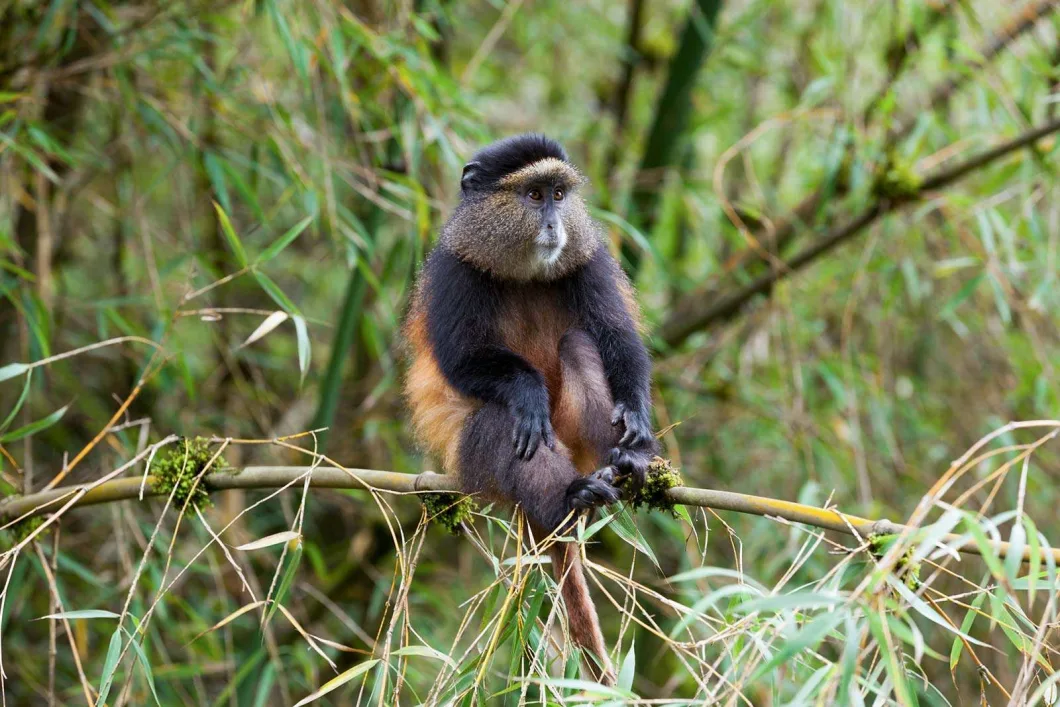
Habituated golden monkey families in Volcanoes National Park:
Kabatwa Group: This is the first of the two golden monkey groups-ever monitored and studied in Rwanda. It was named after the hill where it was first identified. This group is usually spotted in at the foothills of Mount Sabinyo, always dynamic with 80 to 100 members and is actively studied by conservation groups mainly the Dian Fossey Gorilla Fund.
Musongo Group: This is another habituated golden monkey group in Volcanoes national park, comprising of roughly 100 members and commonly spotted on the slopes of Mount Sabinyo and Mount Karisimbi.
Other places to find golden monkeys
Outside Rwanda, small populations of golden monkeys survive in Uganda’s Mgahinga Gorilla National Park and in Congo’s Virunga National Park, but Rwanda offers by far the most reliable and well-managed trekking experience of the three. Nevertheless, the species remain vulnerable because of limited habitat which at times faces pressures like bamboo harvesting, firewood collection and other human activities.
The Golden Monkey Trekking Procedure
Your adventure day begins with an early, registration at the park headquarters at Kinigi, park headquarters of Volcanoes national park, where all trekkers are expected to report at 7:00 am, gather for a briefing from park rangers, covering park rules, trekking etiquette, and safety guidelines. A maximum of 16 visitors is permitted per troop in Rwanda, and you’ll be assigned a guide and armed ranger to lead you through the adventure.
From headquarters, a short drive brings you to the trailhead nearest that day’s known troop location. Trackers head out ahead of the main group at dawn to locate the monkeys, so by the time you set off walking, your guide usually has a rough idea of where to head. The hike itself is generally gentler than gorilla trekking, taking anywhere from 30 minutes to two hours through farmlands, forest edge, and bamboo thickets, though the terrain can be muddy and an altitude that requires a reasonable level of fitness. Sturdy hiking boots, a rain jacket, and gardening gloves for grabbing at vegetation are worth including to your pack.
Once you locate the troop, you’re allowed to spend one hour observing and following them. Because golden monkeys move constantly through the bamboo, feeding, chasing each other, and leaping between branches, your ranger will guide you on how to stay close to the action while keeping a respectful distance, for both your protection and the monkeys. At times these monkeys move high in bamboo, so cameras with zoom lens and binoculars make your photography the best. The experience is worth the cost.
How Golden Monkeys Communicate
One of the most fascinating aspects of golden monkey tracking is listening to the forest come alive with their calls.
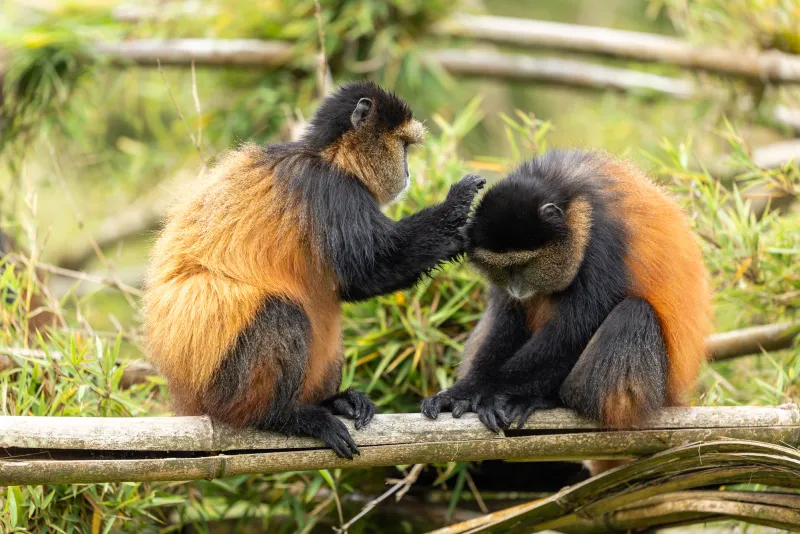
Golden monkeys are highly social animals that live in large, troops, and mainly rely on a rich mix of vocal calls, facial expressions, and body postures to keep the group coordinated. Alarm calls warn troop members of approaching danger, such as birds of prey or other predators, while softer contact calls help individuals stay in touch as they forage across a wide area of forest. Besides communication through sound, grooming is equally an important communicative role, reinforcing social bonds, resolving tension between individuals, and maintaining the hierarchy within the troop. Younger monkeys communicate constantly through play, chasing, wrestling, and mock fighting, behaviour that both strengthens social ties and sharpens the skills they’ll need as adults.
This social behaviour is the main reason the experience feels so lively and breathtaking.
Diet and Feeding behaviour
Bamboo is the backbone of the golden monkey’s diet, and it’s the main reason they’re so closely tied to the specific forest zones where it grows. With scientific research by the Virunga groups, bamboo leaves make up 75 – 87% of the golden monkey diet. They feed primarily on young bamboo shoots and leaves, supplementing this with fruits, flowers, seeds, and occasionally insects. They are recorded to feed on more than 100 plant species, so they adjust their diet according to season and environment.
Their feeding style is fast and energetic; troops move through the bamboo in a rolling wave, stripping shoots and leaves using their teeth and jaws to break the challenging shoots as they go before moving on to fresh growth. This near-constant foraging is one of the reasons sightings feel so lively, and their dependence on bamboo makes the protection of the bamboo important for their survival.
Golden Monkey Trekking Permit Cost
A golden monkey trekking permit in Rwanda costs around 100 USD per person for foreign non residents, US$65 for adults and US$45 for students/children for foreign residents, RWF 4,000 for adults and RWF 2,000 for students/children for Rwandans, : US$65 for adults and US$45 for students/children for East African Citizens and US$80 for adults and US$45 for students/children for East African foreign residents.
The golden monkey trekking permit fee is considerably affordable as compared to gorilla trekking permit thus making it an excellent add-on activity or a standalone adventure for travellers on a tighter budget.
The fee covers the permit itself, ranger guide services, and park entry for that trek. Permits should be booked in advance, ideally through the Rwanda Development Board or a licensed tour operator, especially during peak travel months when demand rises. Unlike gorilla permits, golden monkey trekking is generally easier to secure on shorter notice, though early booking is still recommended to avoid last minute disappointment.
Age limit for golden monkey trekking
Golden monkey trekking is open to a wider age range than gorilla trekking. Golden monkey trekking typically allows children from around 12 years old, to go trekking though this can vary by tour operator and park regulations at the time of booking. This makes it a rewarding family activity for travellers hoping to introduce younger children to wildlife treks that require less demanding physical requirements and abilities.
Best Time for Golden Monkey Tracking
Volcanoes National Park can be visited year-round, for any adventure- including golden monkey tracking, but the two dry seasons, June to September and December to February, offer the best trekking conditions. Trails are firmer, visibility through the bamboo is better, and the overall hike is more comfortable.
However, golden monkey trekking remains enjoyable even in the wetter months of March to May and October to November, since the trekking trails are less steep than gorilla trekking routes and the troops stay active regardless of weather. Rain does bring lusher scenery and fewer crowds, so travellers chasing a quieter experience and the best photography moments sometimes prefer the shoulder seasons for beautiful images.
There is no single month that guarantees no rain fall because the Virungas are covered by dense tropical rain forests where rain pours are unpredictable. Also, no month guarantees the best sightings because the golden monkeys are wild animals whose location and movements at times depend on weather and food availability. So, which ever season you choose to travel, come ready to go hiking.
How Golden Monkey Tracking Supports Conservation
The existence and health of the golden monkeys in Rwanda largely depends on the Virunga forest ecosystem and they are classified as endangered. Every trekking permit sold, the revenue is directly managed by the park, to conduct anti-poaching patrols, habitat and specie protection, and ensure continuous research.
Rwanda also operates a revenue-sharing model that returns part of tourism income to communities living around the park. This helps to build local support for conservation and reduces pressure on the forest from human intervention through their farming activities and resource extraction.
Every trekker who buys a permit directly contributes to the long-term survival of both the golden monkeys and the wider Virunga habitat they share with mountain gorillas, forest elephants, and hundreds of bird species among other wildlife species.
Why You Should Go Golden Monkey Trekking
Golden monkey trekking delivers a wildlife encounter that’s genuinely different from anything else on a Rwanda itinerary. The trek is shorter and less physically demanding, making it accessible to many travelers, including families at a lesser cost.
The permit cost is small is a fraction that pairs easily with a gorilla trek without blowing the budget.
And because golden monkeys are constantly on the move, feeding, playing, and interacting, an hour with them feels unique and full of surprises in a way that few wildlife encounters can match.
The Virunga volcanoes are one of the few places on earth where this particular species can be observed at all, giving the experience of the park’s wonderful biodiversity and unique perspective of every photograph and memory you take home.
Golden monkey tracking is a great opportunity for travellers to support responsible tourism and the continued protection of one of world’s most endangered primate species.
What should you bring for golden monkey tracking?
A good trip starts with smart planning. Wear strong climbing shoes that grip well, long pants, and layers that are easy on the feet. It can get cool and foggy in the Virunga mountains and wet and muddy in the forest.
Some of the useful items include; Waterproof jacket or poncho, Small backpack, Reusable drinking water bottle, Binoculars, Camera with a zoom lens, Sunscreen, Insect repellent, Hat, Light snacks, Walking stick, if you find them useful, and A pair of gardening gloves can also be useful when moving through dense vegetation.
Other Useful Information
Volcanoes National Park sits roughly two to three hours by road drive from Kigali, making it an easy add-on to a Rwanda safari itinerary.
Musanze town, near the park, has a wide range of lodges spanning budget to luxury, so you don’t need to camp to enjoy the experience, though your accommodation choice depends on your budget.
Book your permit in advance, particularly if travelling during Rwanda’s busiest tourism months (June to September). The Rwanda Development Board handles bookings on a first-come, first-served basis. Book early enough to avoid last minute disappointments.
Don’t think that the monkeys will remain in one place. Part of what makes the experience exciting are their constant movements. Listen to your guide and tracker, who often identify the presence of a troop before you as they have more knowledge about the park and the animals.
Follow the park rules and regulations: Keep noise under control, avoid sudden movements and give the monkeys space to behave naturally in their home.
Combining golden monkey trekking with a gorilla trek, a Dian Fossey tomb hike, or a visit to the Twin Lakes region makes for a full and varied adventure in northern Rwanda.
